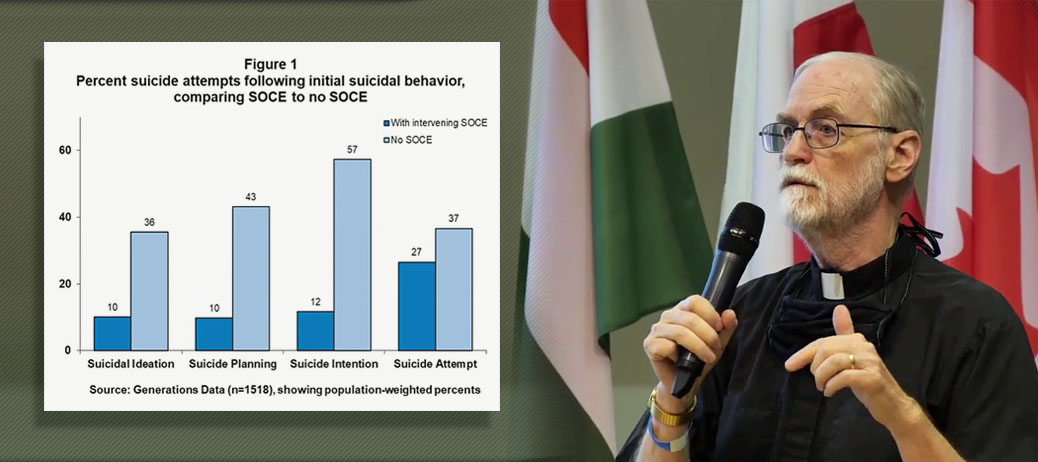
In July 2020, John Blosnich of the Center for LGBTQ+ Health Equity published another study on the "dangers" of reparative therapy. After surveying 1518 non-transgender sexual minorities, Blosnich's team concluded that individuals who had undergone sexual orientation change (SOCE) reported higher rates of suicidal ideation and suicide attempts than those who had not. They argued that SOCE represents a "harmful stressor that increases suicidality in sexual minorities." Therefore, attempts to change orientation are unacceptable and should be replaced with "affirming care" that helps individuals reconcile their homosexual tendencies. The study was called "the most compelling evidence yet that SOCE causes suicide."
However, when another group of scientists, led by Christopher Rosic, analyzed data from "the most representative sample of sexual minorities to date", polar opposite results were revealed. Comparing the scores of people who failed SOCE therapy and those who did not, did not reveal any difference in levels of psychological or social harm - the statistics of both groups were indistinguishable by any measure. Moreover, in contrast, SOCE was found to significantly reduce suicidality: adults treated with SOCE after suicidal thoughts or plans were 17 to 25 times less likely to attempt suicide.
Rosik and other scientists sent a letter to the editor of the scientific journal , noting three major flaws in Blosnich's study: first, the stress attributed to SOCE included all adverse events experienced by the individual throughout their life. Second, the study failed to take into account the individual's state prior to SOCE and did not compare it to a control group that did not engage in SOCE, making the assumption that SOCE is harmful speculative (the link between SOCE and suicidality may be explained by the fact that individuals on the verge of suicide are more likely to seek treatment). Third, the study included only individuals who identified as homosexual, excluding sexual minorities who succeeded in SOCE and ceased identifying as LGBT*.
Rosick's colleague Paul Sullins points out a critical flaw in every study against SOCE: they all report an association of SOCE with suicidality, as if the former caused the latter, completely ignoring the possibility that suicidality may have preceded treatment. Simply relating suicidality to SOCE exposure without time reference violates the "correlation by itself is not causation" standard.
After reviewing the sample data, Sullins came to a startling finding: 65% of suicidal thoughts and 52% of suicide attempts had occurred before SOCE was contacted. Moreover, after undergoing SOCE, the risk of suicide is reduced by 81%. Therefore, Blosnich's research only shows that suicidal people turn to SOCE more often and that SOCE helps them.
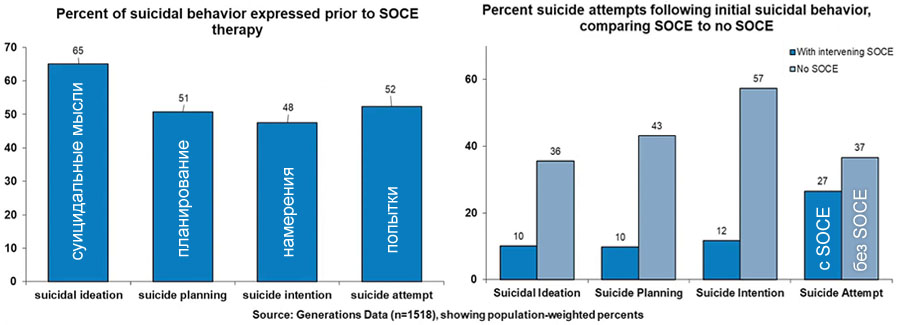
“Imagine a study that finds that the majority of people who use antidepressants also had depressive symptoms,” Sullins explains. “And on this basis, the researchers conclude that people exposed to antidepressants are much more likely to experience depression, and recommend that antidepressants be banned. Isn't that stupid? This is precisely what Blosnich's erroneous and impudent conclusions were that SOCE therapy is necessarily harmful, not beneficial for sexual minorities with suicidal tendencies.
Thus, Blosnich's team drew unwarranted conclusions based on highly inconclusive results. Therefore, concerns about the dangers and harms of SOCE are unfounded, and attempts to limit SOCE may deprive sexual minorities of an important resource for reducing suicidality, thereby increasing the risk of suicide.
The full article by Paul Sullins is available here:
https://doi.org/10.3389/fpsyg.2022.823647
*SOCE - sexual orientation change efforts (attempts to change sexual orientation).
Relatively recently, the news surfaced that homosexual orientation can be determined from a photo with a probability of 82% for women and 92% for men.
Will there be an article on this? I would like to hear scientific rebuttals regarding the relationship of homosexual and bisexual orientation with the face.
The facial features used by the classifier included both fixed (eg, nose shape) and temporal facial features (eg, grooming style). Lesbians tended to wear less eye makeup, have darker hair, and wear less revealing clothing. Homosexuals shaved more often. Straight men and lesbians tended to wear baseball caps.
Have LGBT activists already begun to look for genetic reasons for not wearing baseball caps and cosmetics?
An experimental animal study showed that testosterone suppression affects craniofacial structures during puberty . Low doses of testosterone, when deficient, accelerate growth and craniofacial development, especially in the decelerated components, leading to a normalization of facial size. A higher risk of social isolation was associated with lower testosterone levels. Cortisol, produced under stressful conditions, can influence the action of testosterone and estrogen. Therefore, life circumstances, including LGBT propaganda that convinced a child they were homosexual, may have a minor impact on fixed facial features. This leads to social isolation, changes in hormonal levels, and a person's appearance.
In another study , political orientation was determined from photographs and was correctly classified in 72% of pairs of faces according to the liberal/conservative criterion, which is significantly better than chance (50%), human accuracy (55%), or a 100-item questionnaire (66%).
So that? Are liberals born, not made?
Hello, will there be an article about the life of homosexuals and bisexuals in different countries? That is, do all homos and biseks, without exception, have this culture, religion, etc. mental health the same? And about female homosexuality, the cause of itp ??????
Thanks for the smart answer!
But I still have 2 more questions.
First: is there a need and will there be an article that will study the results of the influence of a certain spectrum of hormones on sexual orientation?
For example, will such studies capture the stereotypical side of the research question? Like those statements that: gay men behave more feminine (do they have higher levels of female hormones compared to heterosexual men?) or that lesbians behave more masculinely (do they have higher levels of male hormones compared to heterosexual women?) and will also Is there a need to understand and study those cases where lesbians and gays are no different (except for orientation) from heterosexual men/women? At least in the sense in which the LGBT community illustrates this.
Second: what is the basis for the allegations that all women are bisexual from birth to one degree or another, and is this true? Why are men less likely to be bisexual then? And do women in general have pansexuality?
Many thanks in advance for your work and forthcoming response!
Who said that women are naturally bisexual? You know, when you watch gays, they do not correspond to their so-called orientation, tell me how much? Well, one wants his partner to introduce himself as a woman, that is, the inner natural desire of a woman, but you don’t need to talk about the other, since they change roles, but everyone, without exception, has this, the desire for the partner to introduce himself as a woman, this applies and women but in reverse in favor of the desire of the man. I don’t know, observing such conclusions are obtained, even regardless of the past and present, culture, etc. also applies to women but in the opposite direction (it is clear that I mean vvizhu). Just observing all this clearly, one can see their unchanging, original nature, the desires of a man of a woman, a woman of a man, they simply confuse an object (a woman or a man) with another, and imagine what a man (women) or a woman (husband) would do, they ask themselves questions that a partner would say, they themselves make compliments, etc. I don’t know again, just observing the same conclusions come
They talk about women's alleged bisexuality only because they tend to spread homosexuality to the largest possible number of people. It's easier for them to absolve themselves of responsibility by dividing it. One crazy woman recently told me that gayness is caused by hormones. My thyroid is reduced and a lack of testosterone was noted. But for some reason I wasn't drawn to men's dicks. They give hormones to traps there. And if it's a matter of them, then some changes should be observed. In general, the hypothesis of hormonal determinacy contradicts their own postulate of the immutability of what they call "orientation". After all, hormonal levels are changeable.
Who said that women are naturally bisexual? You know, when you watch gays, they do not correspond to their so-called orientation, tell me how much? Well, one wants his partner to introduce himself as a woman, that is, the inner natural desire of a woman, but you don’t need to talk about the other, since they change roles, but everyone, without exception, has this, the desire for the partner to introduce himself as a woman, this applies and women but in reverse in favor of the desire of the man. I don’t know, observing such conclusions are obtained, even regardless of the past and present, culture, etc. also applies to women but in the opposite direction (it is clear that I mean vvizhu). Just observing all this clearly, one can see their unchanging, original nature, the desires of a man of a woman, a woman of a man, they simply confuse an object (a woman or a man) with another, and imagine what a man (women) or a woman (husband) would do, they ask themselves questions that a partner would say, they themselves make compliments, etc. I don’t know again, just observing the same conclusions come